Stop Building Tutorial Projects, Start Building Systems
Learn why long-term software systems teach more than tutorial projects and help you grow into a better software engineer.
When I first started learning to code, I built exactly what everyone recommended.
A calculator.
A weather app.
A to-do list.
A movie database.
An e-commerce clone.
Every project taught me something new. I learned React, APIs, databases, authentication, and deployment.
But after months of building project after project, I realized something important.
None of them taught me what it's actually like to build software that people use every day.
That realization completely changed how I approached programming.
The Tutorial Trap
Tutorials are fantastic for learning new technologies.
They teach syntax.
They explain concepts.
They introduce best practices.
But tutorials have one major limitation.
They always end.
Real software never does.
Production applications continue evolving for years. Features are added, bugs are fixed, designs change, requirements shift, and users expect continuous improvements.
That's the part tutorials rarely teach.
Build Something You Actually Need
One of the best decisions I made was to stop asking,
"What project should I build next?"
Instead, I started asking,
"What problem do I have that software could solve?"
That simple question changed everything.
When you build software for yourself, you're much more likely to keep improving it because you experience the problem every day.
Your motivation no longer comes from finishing a tutorial.
It comes from making your own life easier.
Projects End. Systems Evolve.
Most portfolio projects are designed to be finished.
Systems are designed to grow.
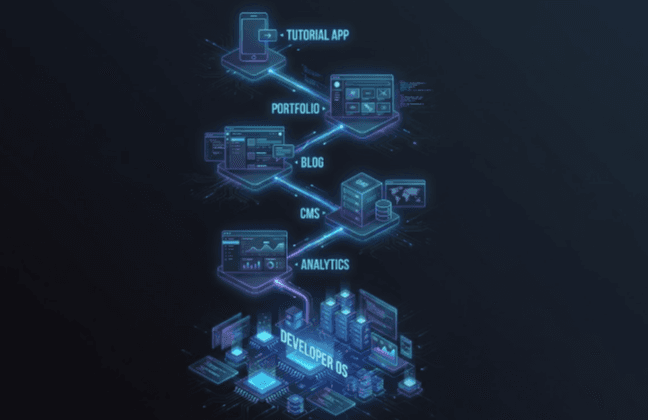
Imagine building a portfolio website.
Most people stop after adding:
- Home
- About
- Projects
- Contact
Now imagine continuing.
Add a blog.
Add analytics.
Add a CMS.
Add authentication.
Add project management.
Add a résumé generator.
Add a job application tracker.
Without realizing it, you've stopped building a portfolio.
You've started building a platform.
Real Software Teaches Different Lessons
Long-term projects expose problems that tutorials never mention.
Questions like:
- How should the database evolve?
- How do I migrate existing data safely?
- How can I improve performance?
- How should permissions work?
- How do I organize a growing codebase?
- How do I avoid technical debt?
These are the kinds of questions professional software engineers solve every day.
Refactoring Is Part of the Journey
Your first implementation probably won't be your best.
That's normal.
As your knowledge grows, you'll naturally revisit older code.
You'll rename components.
Split large files.
Improve APIs.
Optimize database queries.
Replace libraries.
Delete unnecessary code.
Refactoring isn't a sign that you failed.
It's a sign that you've learned.
Build Fewer Projects, Build Better Projects
Many developers believe they need dozens of GitHub repositories.
I don't think that's true.
A single application you've improved for two years often demonstrates more engineering ability than twenty unfinished tutorial projects.
It shows consistency.
It demonstrates ownership.
It proves that you can maintain software instead of simply creating it.
Think Beyond Features
Good developers build features.
Great developers build systems.
When working on a long-term project, you'll naturally begin thinking about things like:
- Scalability
- Performance
- Accessibility
- Security
- Maintainability
- Documentation
- User experience
Those are the skills employers value most.
My Approach Today
Whenever I have an idea, I ask myself one question.
Will I still be using this project a year from now?
If the answer is yes, it's probably worth building.
If the answer is no, I reconsider whether it's the best use of my time.
This mindset has completely changed how I learn new technologies.
Instead of creating disposable demo projects, I integrate new tools into software I already use.
The result is deeper learning and better software.
Final Thoughts
Tutorial projects are an excellent way to begin.
But they shouldn't be where your learning ends.
The biggest improvements in your career will come from maintaining software over months and years.
So instead of asking yourself,
"What tutorial should I follow next?"
Try asking,
"What problem can I solve for myself?"
Because the best projects aren't the ones you finish.
They're the ones that continue growing alongside you.
Over time, you'll realize you haven't just built another application.
You've built a system.
And that's where real software engineering begins.